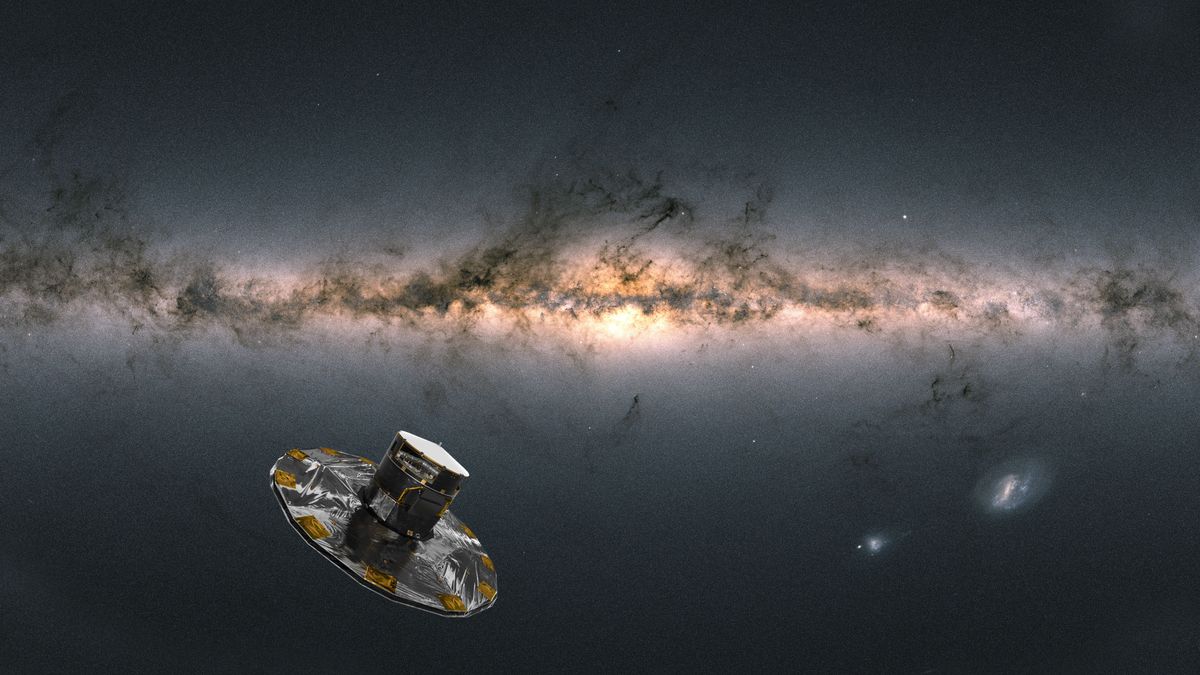

The European Space Agency (ESA) officially announced the retirement of the Gaia spacecraft, marking the end of a decade-long mission that revolutionized our understanding of the cosmos. On Thursday, ESA’s European Space Operations Center powered down all of Gaia subsystems and placed it into a “retirement orbit” around the Sun.
Gaia Legacy: A Decade of Discovery
Launched in 2013, Gaia was initially planned for a five-year mission but far exceeded expectations, operating for a full ten years and collecting a vast amount of astronomical data. The spacecraft’s contributions to science are unparalleled, with its extensive data releases shaping almost every area of astrophysical research.
ALSO READ: Infinix Note 50x 5G Launched in India with Dimensity 7300 Ultimate, 120Hz Display, and Android 15
Johannes Sahlmann, Gaia Project Scientist, highlighted the mission’s significance, stating,
“Gaia extensive data releases are a unique treasure trove for astrophysical research and influence almost all disciplines in astronomy.”
During its operational period, Gaia:
- Provided evidence of past galactic mergers
- Identified new star clusters
- Mapped millions of quasars and galaxies
- Contributed to the discovery of black holes and exoplanets
- Tracked hundreds of thousands of asteroids and comets
Even though Gaia is no longer active, its final data releases will continue to benefit astronomers for years. “Data Release 4” is scheduled for 2026, while the final Gaia Legacy Catalogs will be available no earlier than 2030.
Gaia Decommissioning: A Complex Farewell
Shutting down a spacecraft is not as simple as flipping a switch. Tiago Nogueira, Gaia Spacecraft Operator, explained the complexity of the process, saying:
“Switching off a spacecraft at the end of its mission sounds like a simple enough job. But spacecraft really don’t want to be switched off.”
Gaia was designed with multiple redundant systems to protect against potential failures, requiring an elaborate decommissioning strategy to disable these safeguards. The final commands sent to Gaia included shutting down its communication systems and central computer, marking the last interaction between the spacecraft and its team on Earth.
ESA revealed that hundreds of team members who worked on the mission shared personal farewell messages as Gaia was retired. Mission Manager Uwe Lammers captured the emotional moment, stating:
“We will never forget Gaia, and Gaia will never forget us.”
Gaia Continued Influence on Astronomy
Even though Gaia is no longer collecting data, its past observations will continue to shape astronomy for decades. In June 2022, ESA released Gaia third data set, revealing discoveries such as thousands of starquakes and insights into the “stellar DNA” of the Milky Way.
With its groundbreaking contributions, Gaia has solidified its place as one of the most significant space missions in history. Its collected data will fuel astronomical research, allowing scientists to explore the mysteries of the universe for years to come.