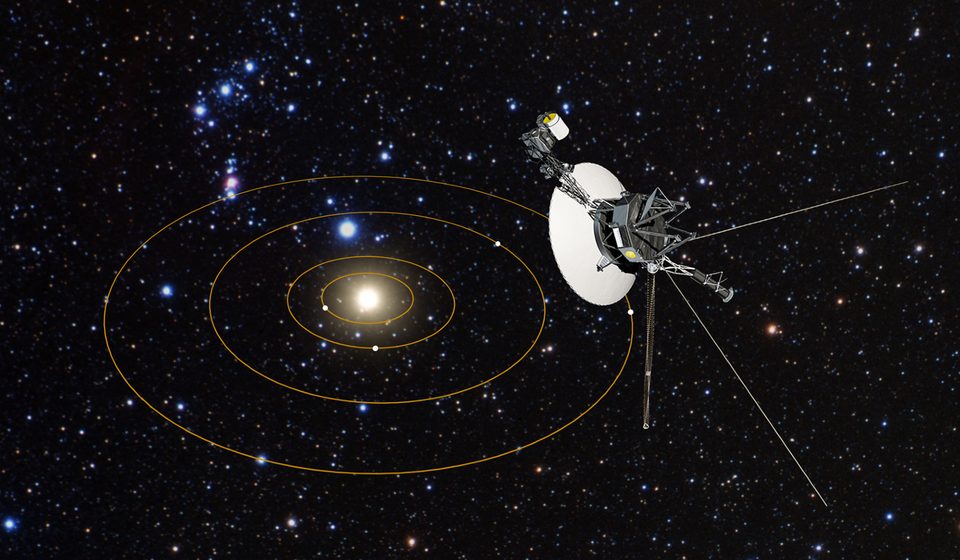
NASA’s Voyager 1 Faces Unexpected Communication Glitch Ahead of Historic Space Milestone

The distant spacecraft temporarily stopped communicating with Earth for two days after a thruster-related issue triggered its onboard safety system. NASA has since restored contact and is investigating the incident.
NASA’s Voyager 1 has experienced another unexpected technical challenge during its journey through interstellar space. The spacecraft, which has been travelling away from Earth since 1977, temporarily stopped sending signals to mission controllers during two scheduled communication sessions in October.
According to NASA, the Deep Space Network could not detect signals from Voyager 1 on October 18 and 19. The communication gap raised concerns among engineers, as the spacecraft is now operating billions of miles away from Earth.
Fortunately, the situation improved on October 20, when Voyager 1 began transmitting signals again. NASA confirmed that communication was restored without the need for engineers to send emergency instructions to the spacecraft.
What Caused the Voyager 1 Communication Problem?
Initial investigations revealed that a set of thrusters on Voyager 1 had unexpectedly shut down. This activated the spacecraft’s automatic protection system, which switched operations to backup thrusters.
NASA engineers are still examining the circumstances behind the shutdown to understand what triggered the incident.
Kareem Badaruddin, Voyager mission manager at NASA’s Jet Propulsion Laboratory, said that the team was happy to regain contact with the spacecraft. He also acknowledged that unexpected technical problems are becoming part of managing such an old spacecraft operating in an extremely distant environment.
Despite the interruption, Voyager 1 continues its mission.
Voyager 1 Is Getting Closer to a One Light-Day Distance From Earth
Another significant milestone is approaching for the historic spacecraft.
NASA estimates that Voyager 1 will be approximately 16.09 billion miles (25.89 billion kilometres) from Earth on November 18, 2026. This distance is equivalent to one light-day, the distance light travels in 24 hours.
The spacecraft is currently moving at approximately 38,000 miles per hour, or 61,155 kilometres per hour.
Reaching this milestone will further demonstrate how far humanity’s most distant spacecraft has travelled since leaving Earth nearly five decades ago.
Why Does It Take Two Days to Communicate With Voyager 1?
The enormous distance between Earth and Voyager 1 makes communication particularly challenging.
NASA uses its Deep Space Network, a global system of large radio antennas, to send commands and receive information from spacecraft operating far beyond Earth’s orbit.
As Voyager 1 approaches the one light-day mark, a radio signal travelling from Earth to the spacecraft will need roughly 24 hours to reach it. Sending a response back will require approximately another 24 hours.
This means mission controllers may have to wait close to two days to receive a reply after sending a message.
Suzanne Dodd, Voyager project manager at NASA’s Jet Propulsion Laboratory, has explained that communicating with the spacecraft involves sending a message and waiting around two days for a response.
A Space Mission That Continues to Make History
NASA launched Voyager 1 on September 5, 1977, to study the outer planets and explore regions beyond the solar system. During its journey, the spacecraft delivered important observations of Jupiter and Saturn before eventually entering interstellar space in 2012.
Today, Voyager 1 remains the most distant human-made object from Earth. Its twin spacecraft, Voyager 2, is also continuing its journey through space.
Although both probes were designed for much shorter missions, their extended operations have provided scientists with an extraordinary opportunity to study the space beyond the Sun’s influence.
The recent communication interruption is another reminder of the engineering challenges involved in operating spacecraft after decades in space. For now, Voyager 1 remains in contact with Earth and continues its historic journey into the unknown.