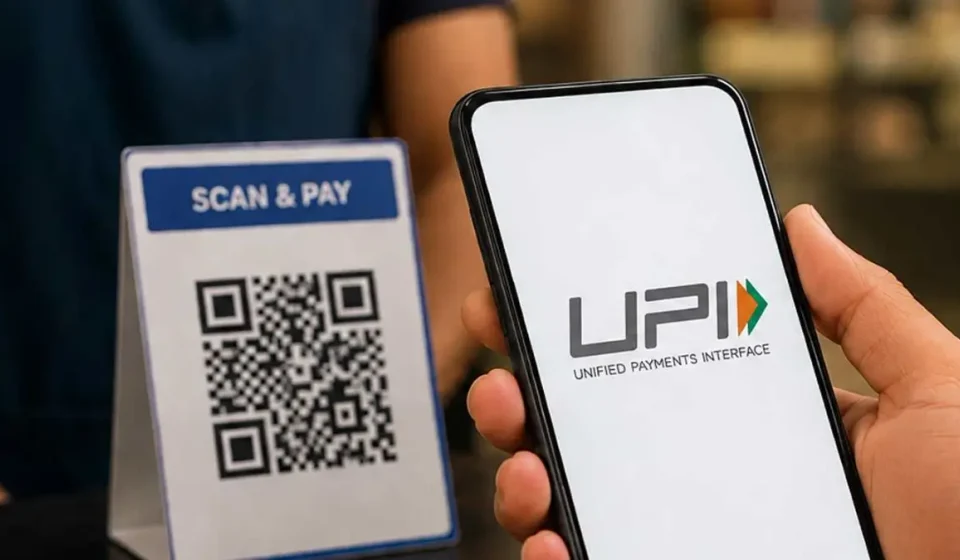

New Delhi: India’s digital payments ecosystem is set for a significant change as a new Merchant Discount Rate (MDR) will be introduced on certain UPI transactions from October 15, 2026.
Under the new framework announced by the National Payments Corporation of India (NPCI), most merchants will have to pay a 0.4% MDR on UPI payments above ₹2,000. However, the charge will not apply to all digital transactions.
The government has maintained exemptions for individuals and eligible small merchants, meaning a large portion of everyday UPI payments will continue without any additional charge.
What is changing for UPI payments?
The new MDR applies specifically to person-to-merchant (P2M) transactions exceeding ₹2,000.
For example, if a customer makes a ₹5,000 UPI payment to an eligible merchant, the transaction will fall under the new MDR structure.
However, person-to-person (P2P) transfers will remain free, regardless of the transaction amount.
Payments made to merchants up to ₹2,000 through UPI or RuPay debit cards will also remain outside the new charge structure.
Small businesses get major exemption
Small merchants have been given a separate exemption under the revised rules.
Businesses classified under the Person-to-Person Merchant (P2PM) category and receiving up to ₹1 lakh per month through UPI QR codes will not have to pay MDR.
This provision is particularly relevant for small retailers, street vendors and other micro-businesses that rely heavily on QR-based payments.
The government believes the exemption will help smaller businesses continue adopting digital payments without facing additional transaction costs.
Will UPI users have to pay extra?
For consumers, the answer is generally no.
Banks have been advised to ensure that merchants do not pass the MDR cost on to customers for UPI transactions.
The 0.4% charge is designed as a cost within the payments ecosystem, with the collected MDR being shared among participating banks and payment service providers.
There is also a maximum limit. For UPI transactions of ₹75,000 or more, the MDR will be restricted to ₹300 per transaction.
Special MDR rates for selected industries
Not every sector will follow the standard 0.4% rate.
Transactions above ₹2,000 involving sectors such as railways, telecommunications, insurance, fuel and agricultural inputs will attract a fixed charge of ₹5 per transaction.
A separate rate has also been announced for financial-market-related payments.
Transactions involving mutual funds, securities, stock brokers and dealers will carry an MDR of 0.02%, subject to a maximum of ₹300.
The lower rate is intended to support retail participation in India’s formal financial markets.
Government expects limited impact
Despite the introduction of MDR, the Finance Ministry expects the impact to be relatively limited.
According to its analysis, only around 4% of merchant transactions are expected to attract the new charge. Most transactions either remain below the ₹2,000 threshold or qualify for the small-merchant exemption.
The government also plans to use 5% of MDR collections to create a dedicated fund for encouraging UPI usage among small merchants.
The fund is expected to support wider QR-code acceptance and digital-payment adoption, particularly among businesses in rural and semi-urban markets.
Why is the MDR being introduced?
The government says the revised system is intended to make the UPI ecosystem more financially sustainable while maintaining its widespread accessibility.
UPI has become one of India’s most widely used digital payment methods, and the new framework seeks to create additional financial support for the payment ecosystem without imposing charges on most routine transactions.
The new MDR structure will be implemented from October 15, 2026.