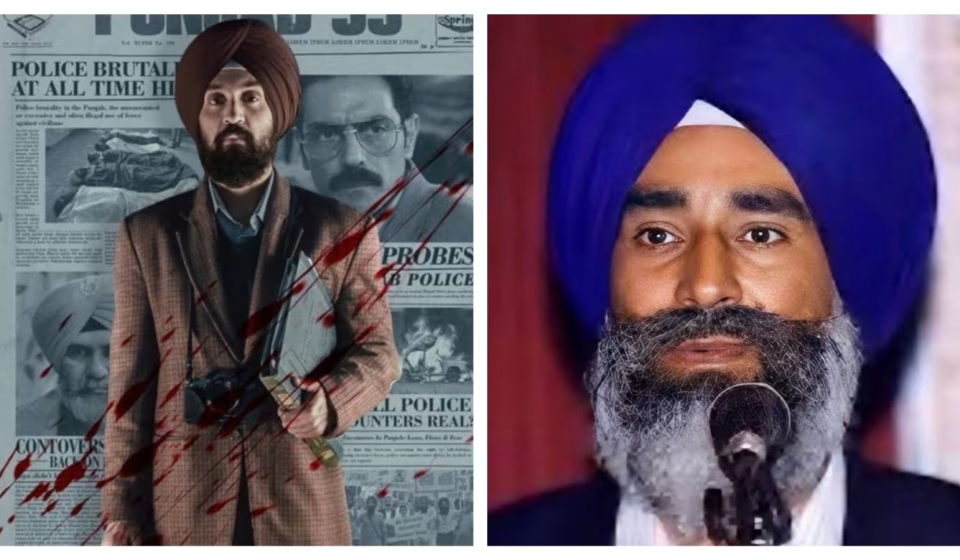
Jaswant Singh Khalra Case Explained: The Human Rights Investigation That Changed India’s Legal History

The abduction and killing of Jaswant Singh Khalra, a prominent human rights activist from Punjab, remains one of India’s most significant custodial disappearance cases. His investigation into alleged illegal cremations during Punjab’s militancy period led to national and international attention, ultimately resulting in a Supreme Court-monitored investigation, convictions of police officials, and a landmark judgment on accountability in custodial killings.
The case has once again entered public discussion following the release of Satluj, a film inspired by Khalra’s life and investigation. While the renewed attention has sparked fresh debate, the legal history of the case remains one of the most important chapters in India’s human rights jurisprudence.
Who Was Jaswant Singh Khalra?
Jaswant Singh Khalra was a Punjab-based human rights activist known for documenting allegations of secret cremations during the state’s insurgency period in the 1980s and early 1990s.
While examining municipal cremation records, Khalra claimed to have uncovered evidence suggesting that thousands of unidentified or unclaimed bodies had been cremated without proper investigation or legal documentation. His research relied on official cremation registers and municipal records, bringing public attention to allegations of enforced disappearances and extrajudicial killings.
On 16 January 1995, Khalra publicly released his findings through a report titled “Disappeared & Cremation Grounds,” alleging that thousands of undocumented cremations had occurred in districts including Tarn Taran, Patti and Amritsar.
Jaswant Singh Khalra’s Abduction
Less than eight months after making his findings public, Khalra disappeared.
According to court records, on the morning of 6 September 1995, he was allegedly taken away by Punjab Police personnel outside his residence in Amritsar while washing his vehicle. Witnesses reportedly saw uniformed officers forcing him into a vehicle before leaving the area.
He was never seen alive again.
His disappearance quickly became a national issue, prompting widespread concern among civil rights groups and political leaders.
Supreme Court Intervention
Within days of the abduction, the matter reached the Supreme Court of India through a habeas corpus petition seeking Khalra’s production before the court.
His wife, Paramjit Kaur, also filed a petition under Article 32 of the Constitution, requesting judicial intervention.
Recognising the seriousness of the allegations, the Supreme Court ordered a Central Bureau of Investigation (CBI) inquiry and transferred the investigation away from the Punjab Police, observing that an independent investigation was necessary to ensure fairness.
The court also directed administrative changes involving senior police officials connected to the case.
This intervention is widely regarded as one of the strongest judicial responses to an alleged custodial disappearance involving serving police officers.
What Did the CBI Investigation Find?
The CBI investigated the matter under the Supreme Court’s supervision between 1995 and 1996.
According to the agency’s findings:
- Khalra had been illegally detained.
- He was held at a police facility before being murdered.
- Multiple Punjab Police officials were identified as accused.
- Senior officers were alleged to have supervised the operation.
During the course of legal proceedings, some accused died before the trial concluded, while others were discharged. Eventually, six police personnel stood trial.
The investigation also contributed to separate proceedings before the National Human Rights Commission (NHRC) regarding allegations of illegal cremations during Punjab’s insurgency years.
Trial Court Verdict
Nearly ten years after Khalra’s disappearance, a trial court delivered its verdict.
On 18 November 2005, six Punjab Police officials were convicted for offences including kidnapping, murder, criminal conspiracy and destruction of evidence.
Initially:
- Two officers received life imprisonment.
- Four others were sentenced to seven years in prison.
Punjab and Haryana High Court Enhanced the Punishment
The sentencing was later challenged.
On 16 October 2007, the Punjab and Haryana High Court enhanced the punishment awarded to the remaining four convicted officials from seven years to life imprisonment.
The High Court held that the gravity of the offence warranted equal punishment for all convicted persons.
Supreme Court Upheld Life Sentences
The convicted officials appealed before the Supreme Court.
On 11 April 2011, the apex court dismissed their appeals and upheld the life imprisonment awarded to all six convicted officers.
The judgment has since been cited as an important precedent concerning custodial violence, enforced disappearances and police accountability in India.
Jaswant Singh Khalra Case Timeline
| Year / Date | Major Development |
|---|---|
| 1984–1994 | Alleged illegal cremations reportedly take place during Punjab’s militancy period. |
| 16 January 1995 | Jaswant Singh Khalra publicly releases findings on alleged secret cremations. |
| 6 September 1995 | Khalra is allegedly abducted outside his Amritsar residence. |
| 11 September 1995 | Supreme Court initiates habeas corpus proceedings. |
| 15 November 1995 | Supreme Court orders a CBI investigation into the disappearance. |
| 1995–1996 | CBI conducts investigation under Supreme Court supervision. |
| 1997 | Former Tarn Taran SSP Ajit Singh Sandhu dies while proceedings are ongoing. |
| 18 November 2005 | Trial court convicts six Punjab Police officials. |
| 16 October 2007 | Punjab and Haryana High Court enhances all sentences to life imprisonment. |
| 11 April 2011 | Supreme Court upholds life imprisonment for all six convicted officials. |
Why the Jaswant Singh Khalra Case Still Matters
Legal scholars and human rights observers continue to regard the Khalra case as one of the most consequential custodial disappearance cases in independent India.
Its significance extends beyond the criminal convictions.
The case demonstrated that allegations against state officials could be subjected to independent judicial scrutiny, reinforced the importance of habeas corpus in protecting individual liberty, and strengthened the role of court-monitored investigations in cases involving alleged abuse of power.
The proceedings also contributed to wider discussions surrounding alleged illegal cremations during Punjab’s insurgency period, prompting further examination before the National Human Rights Commission.
Today, the case continues to be studied in discussions on constitutional rights, custodial violence, police accountability, and human rights law.
Frequently Asked Questions (FAQs)
Who was Jaswant Singh Khalra?
Jaswant Singh Khalra was a Punjab-based human rights activist who investigated alleged illegal cremations and enforced disappearances during the state’s militancy period.
What happened to Jaswant Singh Khalra?
He was allegedly abducted by Punjab Police personnel on 6 September 1995 and was later found, through the CBI investigation and court proceedings, to have been illegally detained and murdered.
Why is the Jaswant Singh Khalra case important?
The case became a landmark in Indian legal history because it resulted in the conviction of police officials and strengthened judicial oversight in custodial disappearance and human rights cases.
When did the Supreme Court deliver its final verdict?
The Supreme Court upheld the life imprisonment of all six convicted police officials on 11 April 2011.
Sources
This article is based on publicly available court records, documented judicial proceedings, CBI findings reported during litigation, and historical reporting relating to the Jaswant Singh Khalra case. It is intended as an informational overview and does not introduce claims beyond those reflected in the public legal record.