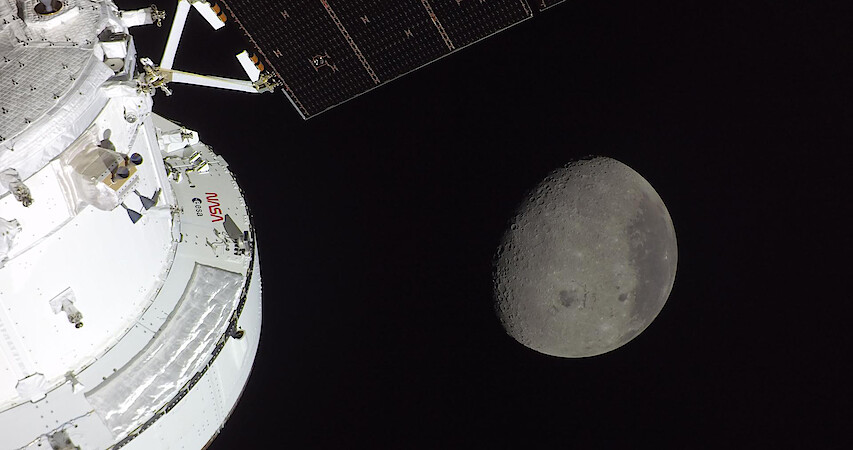

Beijing: NASA Artemis II mission has supercharged the U.S. return to the Moon, ramping up the heat on China to stick to its 2030 crewed landing target—or beat it. The four American astronauts zipped past the Moon’s dark far side this week, venturing deeper into space than anyone alive today, paving the way for a lunar touchdown with Artemis IV in 2028.
China’s watching every move. They’re building a full Moon kit—from the massive Long March-10 rocket to the Mengzhou crew ship and Lanyue lander. Beijing’s already aced robotic sample grabs from both the Moon’s near and far sides, plus nailed space station ops and in-orbit fixes, making them a real player.
No Bigger Win for China
“Landing humans on the Moon is China’s top space prize right now—it’s the key to dominating up there,” says Clayton Swope, deputy director at the U.S.-based Center for Strategic and International Studies (CSIS). The U.S.-led Artemis Accords now square off against China’s and Russia’s International Lunar Research Station (ILRS). It’s less about who arrives first, and more about who sticks around longest and achieves most, notes China’s Nanjing University aerospace prof Kang Guohua.
Hurdles in New Gear
China must prove brand-new hardware—from mega-rockets to moon suits—works flawlessly on debut within four years. Their 2023 plan: Two Long March-10s—one hauls the crew ship, the other the lander. They link up in lunar orbit; two astronauts drop to the surface, snag samples, climb back, dock, and race home. Mengzhou holds up to seven crew, though mission size stays under wraps.
Robotic runs honed lunar comms, docking, and rendezvous. But humans demand ironclad safety. Key tests continue: February’s low-altitude abort nailed Mengzhou’s escape from Long March-10 on Hainan. Last year, Lanyue’s climb-down nailed earth tests in Hebei. Still, testing must speed up for 2030 sign-off. Swope calls China’s steady clip “very plausible,” with no public flops.
Geopolitical Power Play
Beyond tech, it’s a U.S.-China showdown in trade, tech, and arms—with the Moon as fresh turf. U.S. experts flag China’s defense bucks, space diplomacy, private launches, and robot Moon wins as proof they’re gunning hard, even without “race” talk. “China skips the race lingo but aims to rule space,” says Georgetown’s Kathleen Curlee.
China might even be ahead of its word. Lunar chief Wu Weiren told Reuters last year the 2030 date leaves wiggle room: “We Easterners say eight or nine when we can hit ten.” As Artemis II wraps with Pacific splashdown tomorrow, the lunar race feels hotter than ever.